

Sixteen Northern Ireland artists share in UK projects set to receive over £2 million in second Immersive Arts funding round
31st March, 2026
Over £2 million has been allocated to 142 artist-led projects across the UK in the second round of Immersive Arts funding - a scheme supporting artists of all backgrounds and experience to work with immersive technologies. Sixteen artist-led projects in NI are set to benefit.
With three distinct grant amounts available - £5,000, £20,000 and £50,000 – the funding supports artists at different stages of their creative development: to explore, experiment or expand how they make work that uses technology to actively involve an audience.
Eight NI projects will receive Explore grants worth £5,000 each including,
- Ash Ashton, Creating Sensory Environments
- Cameron Clarke, Going Beyond Sound
- Connor Dougan, Deathbed Convert – ‘Immersive Field’ XR Audio Trail
- Domnall Starkie, Smart Swag, MyPace: Sensory Interactive (non-toxic) Seating Design
- Joe Caslin, MA
- Jonathan Brennan, Exploring Unity for narrative-driven MR
- Karen Daye-Hutchinson, Making Worlds
- Maureen McCoy, Man of Arran, augmented reality and 360 filming
Five NI projects will receive Experiment grants worth £20,000 each including,
- Dragos Musat, Lingua Emergent
- Ekaterina Solomatina, Open to Stay
- Eva Robinson, Aura Digital Studios, People Who You May Know
- Glenda Rolston, Echoes of Remembrance
- Niamh Gormley, Lír Pictures, Boa Island Immersive Film
Three NI projects will receive Expand grants wroth £50,000 each including,
- Dee Harvey, Ulster Touring Opera, Carbon Women
- Helena Hamilton, Becoming
- Linda Curtin, Curtin//Keating, At The Edge of Us
Funded artists are working across a breadth of artforms including sound, music, theatre, dance, game design, visual arts, sculpture, photography, animation, architecture and filmmaking. With the support of The Nerve Centre, they will be working with a huge range of immersive technologies including virtual, augmented and mixed reality, 360o film, spatial sound, haptics and tactile interfaces, artificial intelligence, biofeedback and responsive environments. Further details of all funded projects can be found on the Immersive Arts website at immersivearts.uk/projects
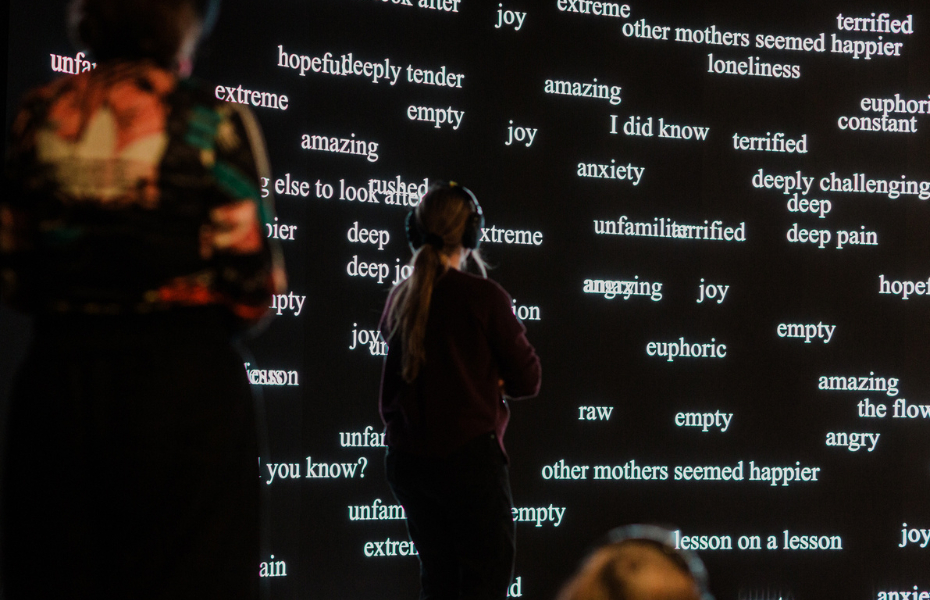
One of the funded projects from Northern Ireland, Becoming, by Helena Hamilton, has been awarded an Expand grant of £50,000 (recipient of Experiment grant in 2025). Becoming is an interactive installation about matrescence, the profound transformation of motherhood. It draws on qualitative research with 25 mothers, reflecting recurring themes including isolation, overwhelm and joy. Many participants described the ineffability of matrescence. In response, the work combines sound, haptics, image and interaction to communicate what language alone cannot.
Helena Hamilton is an artist working at the intersections of visual art, sound, and digital interaction. Their practice explores dynamic relationships between sound, image, and site, bridging the digital and physical to create experiences that evoke meaning rather than impose it.
Helena Hamilton said: “I’m really excited and honoured to be awarded the Expand Fund from Immersive Arts UK. Building on the prototype developed through the Experiment Fund last year, this support will allow me and the team to keep growing Becoming into a public-facing experience, showcasing at Belfast International Arts Festival 2026.”
Director of Strategic Development & Partnerships, Arts Council of Northern Ireland, Javier Stanziola added: “Today’s announcement is welcome news, and the Arts Council of Northern Ireland is delighted to co-fund Immersive Arts along with The Arts and Humanities Research Council and our arts funding colleagues across these islands. This investment will support artists in learning new skills to create art using digital and immersive technologies, and will help widen and diversify audiences, so that more people from all backgrounds can enjoy arts experiences.
“Our investment in digital arts reflects our commitment to creating a sector that is more supported to develop through experimentation and innovation. This Immersive Arts programme encourages innovative practices that cross artform boundaries and builds digital capabilities within our arts sector. We feel it is vital that artists are enabled to keep up with the changing pace of technologies and the changing needs and desires of audiences. Congratulations to all those awarded funding.”
Verity McIntosh, Director of Immersive Arts and Professor of Immersive Arts and Culture at University of the West of England (UWE Bristol), said: “We are delighted to be able to support so many extraordinary UK artists and projects through this latest funding announcement. Our thanks to the incredible partners and funders who continue to make it possible for artists to develop their practice and make bold new works with powerful cultural impact, connecting UK creativity with audiences around the world.”
Commenting on behalf of the programme funders, the UKRI Arts and Humanities Research Council (AHRC), Arts Council England (ACE), the Arts Council of Wales (ACW), Creative Scotland and the Arts Council of Northern Ireland (ACNI), AHRC executive chair Christopher Smith said:“The first cohort of Immersive Arts-supported artists have illustrated how immersive technology can fuel growth and innovation within the arts and culture sector. We are very excited to support an even larger cohort of UK artists through this latest funding round, and very much look forward to following their progress as the work evolves.”
Strengthening representation in immersive arts
Once again, the Immersive Arts team is encouraged to see that artists with a broad range of backgrounds and lived experiences chose to apply to the scheme. Over a quarter of applications and awarded artists in this round are from the global majority, over 55% identify as a woman, transgender, non-binary, genderqueer, agender, or other marginalised gender, and over 45% identify as disabled, D/deaf, neurodivergent or having a long-term physical or mental health condition or chronic illness.
Professor McIntosh added: “Research suggests that each of these communities remain significantly under-represented in the arts and technology sectors, and we are delighted to see such strong representation from incredible artists across the cohort.”
Asha Easton from XR Diversity Initiative, an Immersive Arts consortium partner, said: “In my dual capacity representing the XR Diversity Initiative and the Innovate UK Immersive Tech Network I am deeply proud of the fact that the Immersive Arts programme has attracted applications from artists from an incredibly diverse range of backgrounds and lived experiences from across the whole of the UK.
We are excited to see that diversity continues to be reflected in this cohort of funded projects, exceeding all targets for the second time in a row. I attribute this success to the level of care and detail the team has put into making the application process and programme delivery as inclusive as possible, while always being open and adaptable to the feedback from the artist community we serve.”
Immersive Arts is a 3 year, UK wide programme using an artist-led approach to working with immersive technologies. It is a consortium of partners, led by University of West England and Watershed, and The Nerve Centre leads delivery in Northern Ireland.
Funding for Immersive Arts is provided through a collaboration between the UKRI Arts and Humanities Research Council (AHRC), Arts Council England (ACE), the Arts Council of Wales (ACW), Creative Scotland and the Arts Council of Northern Ireland (ACNI). Funding from Creative Scotland, ACW and ACNI is provided by The National Lottery.
For more details about Immersive Arts visit immersivearts.uk